

VoIP systems have many features that make them a cost-effective alternative to the traditional PSTN (public-switched telephone network). For example, they do not require additional telephone lines and they utilize an existing broadband network to convert voice streams into data packets. The data is sent over the Internet to their destination, which can reduce how much money is spent on voice related communication.
Premise Wiring:
An often overlooked element that customers don't think a lot about is the physical wiring within the office space. Companies looking to make the move
to a VoIP service, should at the least have at least 1 'hard-wired' connection at each location a VoIP phone will reside. This connection should be
at least Category 5 (Cat5e) type and should be correctly installed and terminated in the wiring closet or back-office server room. For new installations
companies should consider installing two independent Category 5e type connections for each location.
Network Switching:
To help ensure your VoIP system will perform well with good audio quality, the next component companies should examine is the network switching hardware.
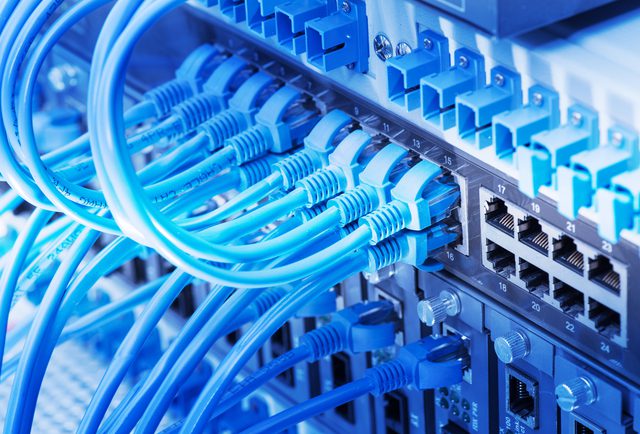
Network switching is the device that distributes network connectivity to all the computers, devices and phones on your network. Network switches should
be 'business' or 'enterprise' class and properly configured to allow proper routing of VoIP protocols. Network switches should be configured to
prioritize VoIP traffic. Additionally, your network switches may have the ability to perform packet inspection, which should be disabled.
We have seen many customers experience call quality
and connectivity issues that were related to misconfigured network switches and routers so this device should not be overlooked.
Routers:
Probably the most important device as it controls all internet traffic in and out of your network. Network administrators should configure NAT and PAT
properly as VoIP performs best within a Dynamic NAT/PAT scheme. There also should not be any outbound filtering of VoIP traffic and SIP Packet Inspection
should also be disabled if available. Most 'business' and 'enterprise' class routers can also implement QoS (Quality of Service) and should be implemented
to prioritize VoIP protocols.
Companies should also consider having static addresses for their networks. Voigo utilizes an IP Blocking Scheme and although not required, a static IP
address space will eliminate the need to setup and maintain a DDNS configuration hosted online.
"A router is the most important device as it controls all internet traffic in and out of your network."
Have a Backup Broadband Connection:
Enterprises today rely heavily on their broadband connection, so it's important to implement a backup connection in the event your primary access goes offline.
This will ensure you do not see any downtime with your VoIP phone system should you experience a connection outage.
Summary:
Today, VoIP is a great alternative to legacy phone systems that are difficult and expensive to maintain. Voigo's Hosted Voice Services is purpose built
for business at jaw-dropping prices. Contact Us today to find out how much money we can save your business.

In recent years we have seen the convergence of the IP data and TDM circuit-switched voice network on the rise, bringing about many advantages to enterprises. Companies with WAN resources are realizing cost savings, an increase in the number of available productivity and reporting apps and an overall streamlining in company operations as network functions run across an all-IP infrastructure.
Today, technology and platforms are under immense pressure to mitigate security risks. From hacking to ransomware, cloud platforms need to stay on top of the latest security patches and methods to protect services and customer data. Another hot-topic recently has been concerns about data sharing and privacy.
VoIP Security:
Voigo Communications secures VoIP/SIP traffic in a number of ways:
- Employ an IP Blocking Scheme: Voigo's SIP protocol is blocked from unauthorized access on the IP level and customer's networks need to be 'trusted' to connect.
- Our SIP Ports have been customized so that SIP and VoIP scanners have a harder time finding our platform
- Your VoIP devices connect via a secure VPN connection.
- Mobile devices connect via SSL/TLS on non-standard SIP ports.
Fail-over and Backups:
Each voice server in the Voigo Voice Cloud is deployed with a 'hot-standby' server with real-time data and file replication.
If the primary server your company is connected
to were to fail or stop responding to SIP requests, an automatic fail-over to the standby server will begin. The switch to the standby
server takes just a few seconds to complete. The standby server is a full function platform, so there will be no
reduction performance or features. Customer's inbound numbers will also automatically switch to the standby servers as our
underlying carrier network also have fail-over redundancy.
Data backups are performed daily, automatically and periodically tested. Data backups are moved from one data center to another so all your call and billing data will never be lost.
Monitoring:
Our entire platform is monitored for performance and unauthorized access. The monitoring systems sends out alerts to our
network operations staff in real-time in the event of an outage.
Data Sharing:
Voigo will never share, sell or disseminate any of your data. As a VoIP provider, Voigo is required to follow FCC Customer Proprietary Network Information (CPNI)
rules and regulations. We are also required to officially alert customers and the FCC in the event of any data breach, or any other unauthorized release of any
CPNI data.